How Work Affects Diabetes Control
May 21, 2026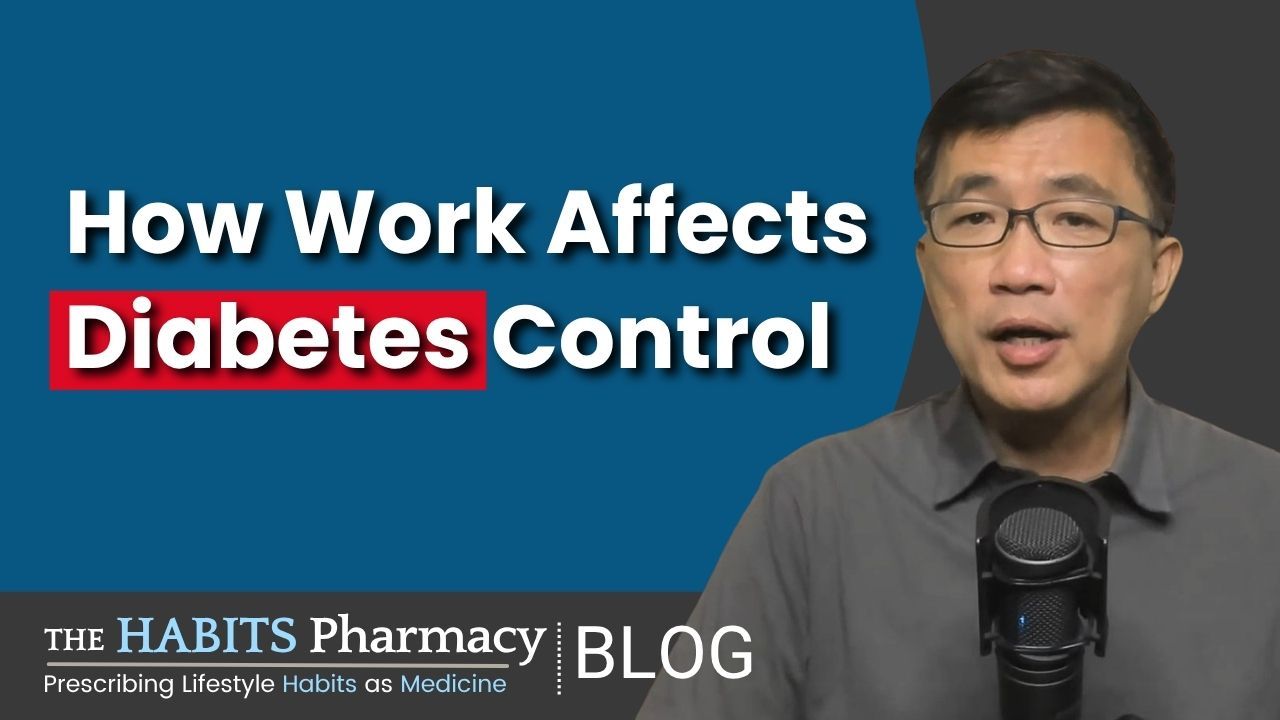
If you have diabetes, how often has work been the reason you could not eat better, exercise more, sleep properly, or manage your stress?
If your honest answer is "very often," you are not alone. This is one of the most common things I hear from my patients with diabetes and from participants at my workshops and coaching programmes.
Watch the short video below, or read on.
How Work Affects Diabetes: The Many Ways
Work does not affect diabetes in just one way. It affects it from multiple directions at the same time.
I have patients who work in industrial areas where the only food available nearby is canteen food or fast food. They have very little control over what they eat during working hours. I have patients who travel frequently or entertain clients regularly, where the food choices are made by others and saying no is socially complicated.
I have patients who do shift work or work across time zones, sometimes through the night. Their sleep is disrupted chronically. And poor sleep, as I often explain to my patients, directly affects blood sugar control and makes the body more resistant to insulin.
I have patients in desk-bound jobs who sit for ten to twelve hours a day. They know physical activity matters for diabetes management. But by the time they finish work, they have no energy left to exercise. And the weekends are taken up by recovery and family obligations.
Every work situation is different. But the common thread I see running through almost all of them is this: a quiet resignation that nothing can be done. That work is the immovable obstacle. My diabetics know that lifestyle change to better combat diabetes is much needed, but they will have to wait, because work and the challenges it brings comes first.
Overcoming Diabetes Begins With The Mind.
It is not the work situation itself that worries me most. It is the mindset, one of resignation that comes with it.
When a patient tells me their work makes it impossible to change their eating habits or exercise regularly, what I hear underneath that is: I have decided this problem cannot be solved. And once that decision is made, nothing changes. The blood sugar stays poorly controlled. The medications go up. The complications begin their slow and silent accumulation.
I empathise fully with how genuinely difficult work makes things. I am not dismissing the real obstacles. But I have to be honest with my patients. Diabetes does not slow down because you are busy. The progression of diabetes and the development of its complications do not pause because your work schedule is demanding. The window to act does not stay open indefinitely.
Waiting for work to become less demanding before making lifestyle changes is, in most cases, waiting forever.
The Storyline I See Too Often
Let me share a pattern I have seen repeated many times in my years of practice.
A person is diagnosed with diabetes in their thirties or forties, a stage of life where work takes priority. Life is busy. They tell themselves they will sort out their diet and exercise habits when things slow down, when the project is over, when they retire.
They retire in their late fifties or sixties. And instead of enjoying the freedom and the time they worked so hard for, they spend their retirement managing complications. Kidney problems. Eye problems. Nerve damage in the feet. Cardiovascular disease. Hospital visits. Medical bills that consume the savings they planned to enjoy.
This is not inevitable. But it becomes far more likely when lifestyle and eating habits changes are repeatedly deferred because of work.
Health is precious. And the time to protect it is not when you finally have time. It is now, whilst the window is still open.
The First Step Is Not a Solution. It Is a Decision.
I want to be honest here. I do not have a universal solution to the problem of how work affects diabetes management. Every person's work situation is different. There is no one-size-fits-all answer.
What I do know is this. The first and most important step is not finding the perfect solution. It is making the decision that you will find your own solution. That you will do whatever it takes, within your specific work situation and constraints, to improve your lifestyle and eating habits to better manage your diabetes.
Start now. Start today. Do something.
Learning About Reversing Type 2 Diabetes
If you have Type 2 diabetes and are not as equipped with the essential foundational knowledge about reversing Type 2 diabetes as you should be, I have a structured online learning programme that you might find very useful. You can find out more through the link below.
Related Posts
- Can Type 2 Diabetes Be Reversed? Dr Chan Answers
- Stress and Diabetes: The Silent Destroyer
- Stress, Sleep and Strength: Lifestyle Habits Beyond Diet
- Eating Habits and Diabetes: Why Family Is the Key
About Dr Chan Tat Hon
Dr Chan graduated from the National University of Singapore medical school in 1992. For the last ten years, his work has focused on lifestyle medicine. He works with healthcare and corporate organisations to design and deliver lifestyle behaviour change programmes, train health coaches and build communities engaged in cultivating healthy behaviours to combat diseases.
He also provides training and coaching to individuals with diabetes, hypertension, high cholesterol, cardiovascular diseases and other lifestyle-related chronic diseases through 1-1 personalised coaching, live webinars, and online courses.
- 1-1 Personalised Coaching with Dr Chan
- Online Courses and Programmes by Dr Chan
- Reversing Type 2 Diabetes: Essential Basics Online Programme
- LinkedIn Profile of Dr Chan Tat Hon
About This Video
In this video, I talk about the many ways work affects diabetes management, from limited food choices and client entertainment, to shift work, disrupted sleep, and sedentary desk-bound jobs. I share a pattern I see repeatedly in my practice of patients who defer lifestyle changes until retirement, only to spend those years managing complications. And I explain why the first step is not finding a perfect solution, but making the decision to find your own.
Full Video Transcript
The following is the full transcript of the video above.
Work affects a person's sleep, stress, physical activity level, as well as the ability to make the necessary changes to the exercise and eating habits, all of which are factors that will significantly affect blood sugar control, the progression of diabetes, as well as the risk of diabetes complications. Do you have diabetes or do you have family members who have diabetes? I would like to talk about the relationship between work, lifestyle, and diabetes.
In my many interactions with people with diabetes, whether the patients that I see in my clinic or people who attend the various workshops and programs that I conduct, work environment, work stress, work demands often come up as one of the key impediment, key obstacle to their willingness or ability to make the lifestyle habits change necessary for optimal diabetes management. For example, I have had diabetes patients telling me that they think they are not able to make the necessary changes to their eating habits because they work in industrial areas where food options are limited, or because they travel or have to entertain clients frequently and they have limited influence or control over the kind of food that they eat.
I also have diabetes patients who do shift work or regional jobs that require them to work in the middle of the night with colleagues from different time zones, severely affecting their sleep quality and disrupting their sleep routines. I also have many patients who work long hours in desk-bound jobs and because of that lead very sedentary lifestyle even though they know that exercise is important for optimal diabetes management.
Although everyone's work situations and demands are different, the common thread cutting across almost all my workshop participants or patients with diabetes is this: a resolution that they would not be able to do anything about how their work is adversely affecting their lifestyle and eating habits and consequently the ability to prevent, control and combat diabetes optimally.
So one of the most important things that I found myself having to do for my patients with diabetes is to counsel them to change their defeatist mindset that it would be impossible to improve their lifestyle and eating habits because of the work environment and demands. I would highlight to them that whilst I fully empathize with them on how their work makes lifestyle and eating habits change difficult or seemingly impossible, it is not something that they can afford to put off, because the progression of diabetes and its many devastating complications would not wait or slow down just because they are stressed by or busy with their work.
I often have to spend a lot of time over many sessions over many months to counsel my diabetes patients, to bring them to the reality and the acceptance that if they were to prevent or reduce the many devastating complications of the diabetes they have, they have to make the necessary changes to their lifestyle and eating habits in spite of the stress, demands and challenges of their work, and without any delay, even if their blood sugar is already well controlled through medication.
A very common and also a very sad storyline that I often see repeated for many people with diabetes is one in which a person put off making the necessary critical changes to the lifestyle and eating habits during their working life until they retire in their 50s or 60s, and then spend their post-retirement years suffering from many complications of diabetes, so that instead of enjoying their free time and hard-earned money during their retirement, they have to spend a lot of time and a big bulk of their money on medical bills, tackling chronic diseases as well as the many serious complications of diabetes.
I made this video not because I have the answers, the solutions to this problem that many people with diabetes have in not being able to, or putting off because of work, making the critical changes to lifestyle and eating habits to better control and combat diabetes. In any case, every person's work environment, moments and challenges are different and there is no one-size-fits-all solution to the problem.
I made this video because lifestyle and eating habits play such a significant role in preventing and combating diabetes complications that making the necessary changes to one's habits is not something that can be put off because of work demands and challenges. Even when one does not have the answers, the first and most critical step to tackling any problem is to acknowledge the problem and then making the decision to do whatever it takes to find one's own answers, one's own solutions to the problem.
So if you have diabetes and you want to prevent or reduce the complications of diabetes, you need to make the decision to do whatever it takes to change and improve your lifestyle habits. And you have to do this in spite of the work challenges, and you cannot afford to wait for your work situation to become more conducive to do so. The progression of diabetes and the development of complications of diabetes will not wait just because of your work situation and demands.
Hi, I'm Dr Chan. I am a practicing medical doctor from Singapore. I'm also a trainer and coach. I spend a lot of my time conducting workshops, courses and coaching programs in lifestyle and eating habits modification. For a period of five years up to 2019, I was also the full-time head chef at the restaurant that I started and used as a living classroom to encourage and equip people to change their eating habits. My passion, mission and work is in activating and enabling people to modify their lifestyle and eating habits to combat lifestyle related chronic diseases. I'm Dr Chan. Let Habits be Thy Medicine.
---------- End of video transcript ----------

About Dr Chan, Founder & Medical Director of The Habits Pharmacy
Dr Chan is a medical doctor from Singapore who trains and coaches people to holistically review, change and improve their Lifestyle & Dietary Habits to prevent, control and combat Diabetes, Hypertension, High Cholesterol, Cardiovascular Diseases and other Lifestyle & Diet related chronic diseases. Find out more about Dr Chan, his work, 1-1 coaching programmes, workshops & courses, click on the Find out More button below.
Subscribe to
The HABITS Pharmacy - Habits as Medicine
newsletter
for regular tips & updates on courses and workshops to be equipped to unlock the Power of Habits as Medicine to Prevent and Combat Lifestyle-related chronic diseases.
Unsubscribe anytime