Stress, Sleep and Strength - Beyond Dietary Habits for Diabetes
May 02, 2026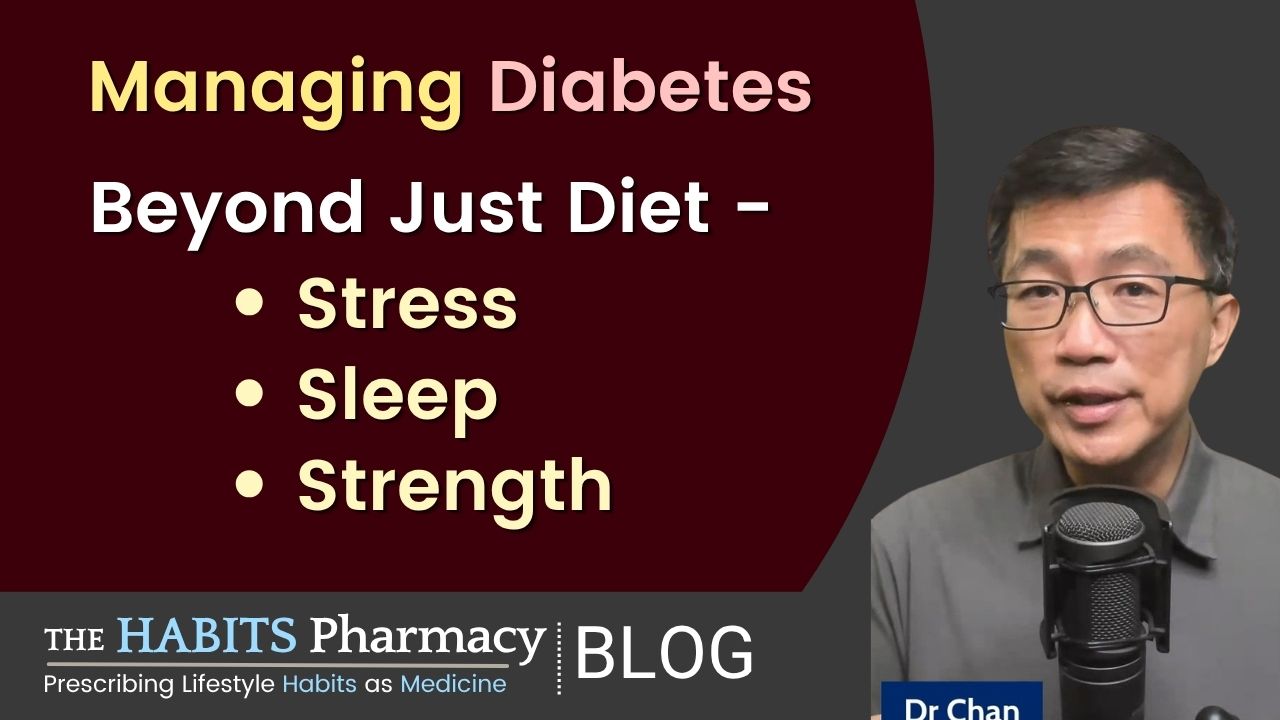
Most people with diabetes spend a lot of time thinking about what to eat.
Which rice. Which bread. Which sugar. Keto or plant-based. Brown rice or white rice. Honey or table sugar. Sourdough or wholemeal. Whether oats are good or bad. Whether bitter melon actually works.
These are not bad questions. Diet matters enormously. But here is what I observe in my clinic again and again.
Patients who are very focused on their diet. Who have done their research. Who have switched to lower GI options, cut out sugary drinks, and carefully chosen what goes on their plate. And yet their diabetes control is still not where it should be.
Why?
Because they are only looking at part of the picture.
Other than diet and exercise, there are three lifestyle habits that also play a significant role in blood sugar control and the holistic management of diabetes. Three habits that most people with diabetes are not paying nearly enough attention to.
They all start with S. Stress management. Sleep. Strength exercises.
Watch my short video below, or read on.
Stress and Diabetes - Including the Stress of Worrying About Diabetes
Most people with diabetes know, in a general way, that stress is not good for them. But knowing something in a general way is very different from truly understanding its impact.
What I see in my clinic is this. Many patients are so worried about their diabetes, so anxious about their blood sugar numbers, so intensely focused on micro-managing every aspect of their diet, that this worry and hyper-focus itself becomes a significant source of stress.
And that stress is paradoxically worsening the very thing they are trying to manage.
They are working hard. They are disciplined. They are doing everything they believe is right. And the effort itself is part of what is holding them back.
This is one of the more difficult things to communicate to a patient who is already trying their best. But it is one of the most important observations I can share.
If you want to go deeper on how stress directly and indirectly affects blood sugar control, you can read my posts on 7 ways stress affects blood sugar levels and stress as the silent destroyer of diabetes management.
Sleep and Diabetes - The Habit That Gets Sacrificed First
Sleep is almost never on the radar when people think about managing their diabetes. Diet is on the radar. Exercise is on the radar. But sleep rarely comes up in the conversation, even though it has a real and direct impact on blood sugar regulation and insulin sensitivity.
Here is what I see happening.
The same anxiety and stress that I described above affects sleep. Patients worry about their diabetes. They lose sleep over a blood sugar reading that was higher than expected. They lie awake turning over what they ate that day, what they should have eaten instead, what they are going to do differently tomorrow.
And then there are the patients who are burning the midnight oil researching diabetes. Watching videos. Reading articles. Going deep into forums and studies. All of it motivated by genuine desire to do better. But the late nights chip away at the very resource their body needs most to regulate blood sugar effectively.
The shift workers are in a particularly difficult position. Many are not even aware that their irregular sleep patterns are impacting their blood sugar control. And when this is highlighted to them, the honest reality is that there is often not much they can do about it, short of changing jobs, which is either not possible or not something they want to do.
For shift workers with diabetes, acknowledging this reality is important. It does not mean giving up. It means being more intentional about every other habit within their control, and working closely with their doctor to manage what cannot easily be changed.
Strength Training and Diabetes - Completely Off the Radar
Of the three, strength training is the one that is most completely absent from the conversation.
When people with diabetes think about exercise, and when friends, family, and even some healthcare professionals give exercise advice for diabetes, the conversation is almost exclusively about cardio. Walking. Jogging. Swimming. Cycling. HIIT. These are the exercises that come to mind.
Strength training simply does not enter the room.
And yet building and maintaining skeletal muscle mass matters significantly for blood sugar regulation. Muscle is metabolically active tissue. It plays a real role in how the body handles glucose.
I am not saying stop your cardio. Walking is powerful medicine and I prescribe it consistently. But if strength training is not part of your exercise picture at all, there is something important missing.
Strength building does not require a gym membership or heavy weights. There are exercises that can be done at home, with bodyweight alone, that build and maintain strength effectively. What matters is that you start, and that you do it safely. Work with your doctor before starting any new exercise programme, and if possible work with a qualified trainer who can guide you well.
Combating Diabetes Requires the Full Picture
Diet matters. Getting your eating habits right is foundational and I would never minimise that.
But if you are already working hard on your diet and your diabetes control is still not where you want it to be, I would encourage you to honestly ask yourself these three questions.
How is my stress? Not just general life stress, but the specific anxiety of managing a chronic condition.
How is my sleep? Quantity and quality.
Am I doing any strength exercises at all?
If any of these answers concerns you, that is where some of your untapped medicine is.
Take it one step at a time. One habit, one dose at a time. Our lifestyle habits can be powerful medicine for combating diabetes. We just need to learn to unlock all of them, not just the ones that are easiest to see.
Ready to Build the Right Foundation?
If you want to understand what it really takes to reverse Type 2 diabetes, not just manage it, I created a structured online learning programme to give you the complete and integrated picture.
Not fragments. Not piecemeal information. The whole thing, in sequence, so that you understand how diet, lifestyle habits, and the full picture of diabetes management connect, and what it means for your situation specifically.
Find out more about the Reversing Type 2 Diabetes: Essential Basics Programme here.
Start now. Start today.
Let Habits be Thy Medicine.
Dr Chan Tat Hon
Related Posts
- 7 Ways Stress Affects Your Blood Sugar Levels and Diabetes Control
- Stress and Diabetes: The Silent Destroyer
- Can Diabetes Be Reversed? Dr Chan Answers
- Reversing Type 2 Diabetes: Essential Basics Programme
Video Transcript
What do you think are the 3 most underrated Habits as Medicine for Diabetes? Or put it in another way, what are the 3 lifestyle habits that have the potential to prevent, control and combat Diabetes that most people are ignorant of, that many people, including those with Diabetes, tend to neglect or underestimate the power of.
Welcome to another episode of The Habits Doctor Podcast, your go to place for information and inspiration to start taking action to unlock the Power of Habits as Medicine to prevent and combat lifestyle-related chronic diseases. I am Dr Chan, Your Host.
In this episode, I would like to challenge you to have a fresh look at the relationship between Lifestyle habits and Diabetes. In particular, I would like you to try answer this question: other than diet and exercise, the 2 lifestyle habits which most people know are key in combating diabetes, what are other lifestyle habits that also have significant impact on diabetes? Whether it is from the perspective of prevention of Diabetes for people who do not have diabetes, or from the perspective of improving blood glucose control for those who have diabetes?
There are 3 lifestyle habits other than Diet and Exercise that also play significant roles in preventing and combating diabetes that many people are ignorant of or neglect. These 3 Lifestyle Habits, are in my view the 3 most underrated Habits as Medicine for combating diabetes. What do you think they are?
I shall give you a clue, they all start with S. They are Sleep, Stress Management and Strength Exercises.
I included Strength Exercises in this list even though I had said, other than Diet and Exercise, because most people with diabetes would often only think about cardio or aerobic exercises such as walking, running, cycling or swimming and neglect muscle building strength exercises. Strength building exercises are not limited to going to the gym to lift weights or do resistance training. There are many exercises that can be done outside of a gym that can help to build and maintain strength and skeletal muscle mass. As always, work closely with and consult your doctor before embarking on any new exercise regime. If you can, work with a trainer who can customise and train you to do strength and muscle building exercises well and safely.
Stress Management and Sleep Habits are the other two areas that many people with diabetes often do not realise have tremendous impact on their blood sugar control as well the overall management of diabetes including preventing and combating diabetes complications.
From my interaction with my clinic patients and workshop participants who have diabetes, these 3 lifestyle habits are often the most neglected and the most underrated lifestyle habits for the holistic management of diabetes, habits which if optimised and practised consistently have tremendous power as medicine to combat diabetes effectively.
I would not go into the details of the different mechanisms of how each of these habits contribute to better blood glucose control, other than to say that these 3 lifestyle habits affect insulin sensitivity and consequently blood sugar control, amongst other physiological effects. You can find links to some relevant scientific studies and articles in my blog post on this subject.
Combating diabetes is more than just about achieving better blood sugar control, and it takes more than just improving one's diet and doing aerobic exercises regularly. If you have diabetes you should combat it holistically by paying more attention to and optimising your habits in these 3 areas, they would not only help improve blood glucose control but would also, more importantly contribute to preventing and combating the many devastating complications of diabetes.
Go learn more about it, attend a course or join a programme or speak to your doctor, your diabetes educator, or your health coach. Do whatever you are willing and able to do to learn more, do more to unlock the power of your lifestyle habits as medicine to combat diabetes.
Combating diabetes effectively requires not only Lifelong learning but also lifelong doing in the form of learning, modifying, and optimising all aspects of our lifestyle habits. It is easy to feel a little overwhelmed. Don't. Take it one step at a time. Our lifestyle habits can be powerful medicine in combating diabetes. We just need to learn to unlock it. One habit one dose at a time.
If you think having a regular dose of bite-sized information and inspiration to support you in your journey to unlock the tremendous power of lifestyle habits as medicine is helpful, you may want to sign up for my Habits as Medicine newsletter. Go to www.HabitsMed.com. I hope you have enjoyed this bite-sized episode of The Habits Doctor Podcast. I am Dr Chan. Let Habits be Thy Medicine.
About Dr Chan, Founder & Medical Director of The Habits Pharmacy
Dr Chan is a medical doctor from Singapore who trains and coaches people to holistically review, change and improve their Lifestyle & Dietary Habits to prevent, control and combat Diabetes, Hypertension, High Cholesterol, Cardiovascular Diseases and other Lifestyle & Diet related chronic diseases. Find out more about Dr Chan, his work, 1-1 coaching programmes, workshops & courses, click on the Find out More button below.
Subscribe to
The HABITS Pharmacy - Habits as Medicine
newsletter
for regular tips & updates on courses and workshops to be equipped to unlock the Power of Habits as Medicine to Prevent and Combat Lifestyle-related chronic diseases.
Unsubscribe anytime