Are oats good for diabetes? Dr Chan answers
Apr 19, 2026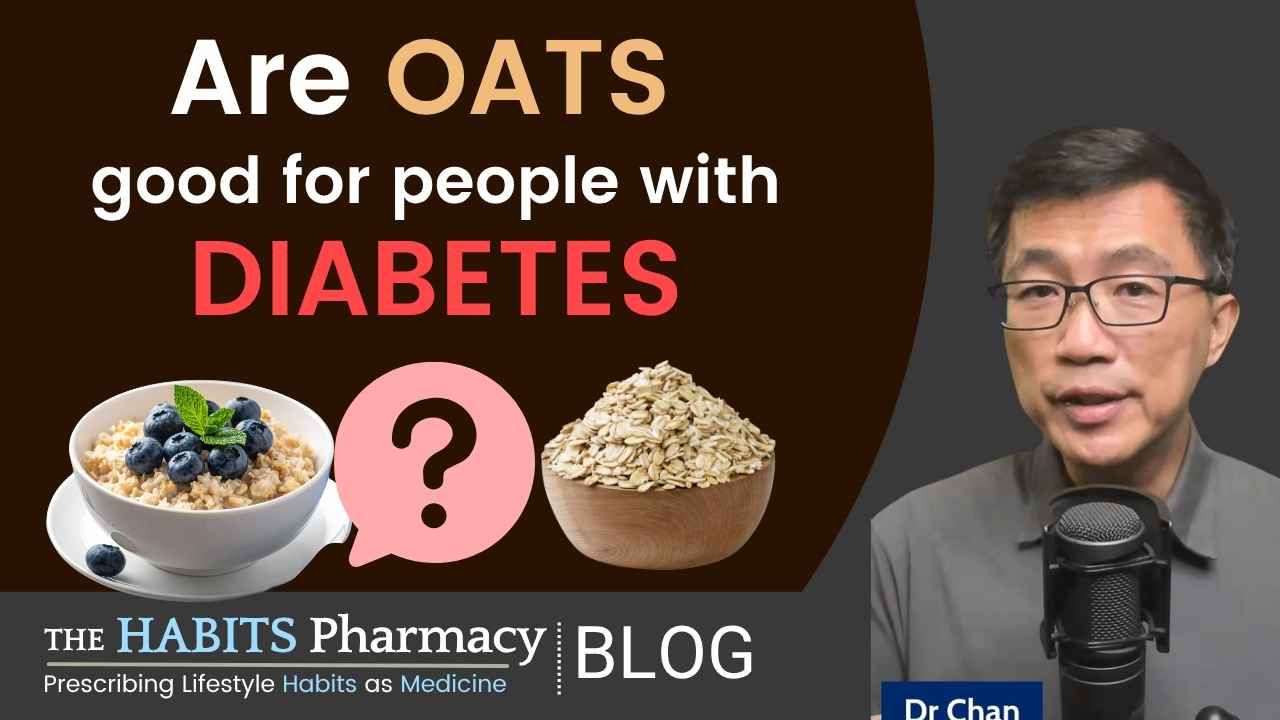
Are Oats Good for Diabetes?
"Doctor, are oats good for diabetes?" is a question I get asked very often during my habits as medicine workshops or during 1-1 coaching I do at my clinic or online for people with diabetes. I did this video that I hope would help people learn to ask more specific questions to get more useful and specific answers as to whether they should increase or reduce their intake of oats. Video embedded below.
Synopsis of "Are oats good for diabetes?" video
Are oats good for diabetes? The general answer is that oats are usually a “can have” or “good to have” food for people with type 2 diabetes. They are neither a must-have food that everyone should take, nor a must-avoid food that should be eliminated completely. However, this type of general answer is often not the most useful or actionable for an individual.
A more helpful approach is to ask a more specific question: should you personally add, reduce, or remove oats from your diet? The answer depends on several factors, including how severe your diabetes is, how well your blood sugar is currently controlled, and how your overall diet is structured. It also depends on why you are choosing to eat oats, what type of oats you are eating, how much and how often you consume them, and how you prepare and combine them with other foods.
Because every person with diabetes is different, the most appropriate answer will always depend on your individual situation. Asking more specific questions allows you to get more useful, practical, and actionable guidance rather than relying on a general statement about whether oats are good for diabetes.
Full transcript of this video is provided below, some might find it useful.
--------- beginning of video transcript ----------
"Are oats good for diabetes?" - a frequently asked question.
“Doctor, are oats good for people with diabetes?” is a question I get asked often, as a lifestyle medicine focused doctor, whether during small group workshops or during one-to-one coaching at my clinic.
“Are oats good for diabetes?” quiz
Do you think that it is:
(A) for people with diabetes oats are ‘must not have’ food
or is it
(B)for people with diabetes, oats are a ‘can have’ food
or is it
(C) for people with diabetes, oats are ‘good to have’ food
or is it
(D) for people with diabetes, oats are ‘must have’ food.
What do you think? Share your answer in the comments.
For people with diabetes. Is it (A) oats must not have food? That oats should be avoided at all costs for people with diabetes or is it (B) that oats are a ‘can have’ food. if you want to have, sure, go ahead, you can have it, Or is it (C) oats are a ‘good to have’ food, that oats are generally good to have and beneficial for people with type two diabetes, or is it (D) that oats are a ‘must have’ food, that oats should be taken by every person with type two diabetes. What do you think? Is it A, B, C, or D? Share your answer in the comments.
“Are oats good for diabetes?” is too general a question.
If you ask me this question in this way, my answer would be it is not A or D. It is not a ‘must not have’ food, neither is it a ‘must have’ food. If you ask me in this way a general question, the general answer that would be correct would be oats are a ‘can have’ and ‘good to have’ food. But I would like to encourage you, or even challenge you to ask better questions so as to get more useful answers, more actionable answers for yourself.
Ask if you should increase or decrease oats in your diet – be specific.
So instead of asking a general question like this, “are oats good for people with diabetes”. A more useful question will be a more specific question to yourself. For example,” I have diabetes. Should I remove or add, reduce or increase oats in my diet?”
And when you ask the question in such a specific way, specific to you, specific to your circumstances, then the answers must necessarily be specific to the answers that you give to these follow up questions such as:
How is your current blood sugar control?:
- Is your diabetes severe or mild?
- Is your blood sugar poorly or well controlled at this moment in time?
As well as “how is your overall diet?” Are you having:
- too much sugar,
- too much starchy foods,
- too little fiber, protein, or even healthy fats in your diet?
And why do you want to have oats in your diet?
- Is it because you love oats?
- Is it because you have high cholesterol and you know that oats is helpful in lowering cholesterol?
- Or is it because you heard that oats are low in glycemic index and that it is good for people with diabetes?
And how are you planning to eat your oats?
- What type of oats? is it still cut Oats, road oats, instant oats.
- How much are you planning to eat?
- How frequently? How regularly? Is it every breakfast Or is it only occasionally?
- How do you usually prepare it, and what would you normally eat it with? Is it just oats on its own? Is it oats with fruits? or is it oats with other high protein, high fat foods and ingredients?
The answer to your specific question about whether you should remove or add, reduce, or increase oats in your diet would depend on your answers in these four follow up questions, because every person with diabetes is different, the answer is therefore, necessarily also different and you want the most appropriate, most useful, most actionable answer to your question and not just a generic, “are oats good for people with diabetes?” in general.
Key takeaways.
So the key takeaways are these, that if you ask a general question “are oats good for people with diabetes?” the answer must be a general one as well. That oats are generally a ‘can have’ or ‘good to have’ food for people with type two diabetes.
But in order to get more useful, more actionable answers for yourself, it is important to ask better, more specific questions. More useful question to us would be, “I have diabetes. Should I remove or add, reduce or increase oats in my diet?”
And in order to come to a good, appropriate answer to that, you must first dive deeper in asking all these follow-up questions.
And you may do well getting a coach, getting a doctor to help you evaluate and assess your overall diet and come up with a dietary change plan and within the overall comprehensive dietary plan, whether you should increase or decrease the intake of oats in your diet.
I can't say this enough, every person with diabetes is different and almost every question that people commonly ask on social media, on the internet about diabetes is a general question, which may be right but may not be the most appropriate for you.
And that it is very important to ask better questions, ask more specific questions that are relevant to yourself in order to get more useful answers.
Reversing Type 2 diabetes may be possible for some
And I want to encourage every person with type two diabetes, reversing type 2 diabetes may be possible, If lifestyle habits are changed and improved early enough, appropriately, adequately and sustainably.
Go and learn more, get some help, most importantly, start now.
I have also developed this structured online learning program to help people with type two diabetes learn the essential basics of reversing type two diabetes. If you're interested to learn more, you can find more information through some links somewhere in this video.
I am Dr Chan.
Your habits can be powerful medicine that will help you prevent and combat diabetes, cardiovascular disease, and other lifestyle related chronic diseases.
Let your habits be your medicine. Eat well and be well.
---------- End of video transcript ----------
Related Posts
- Can Diabetes be reversed? - Dr Chan's FAQs
- My Passion - helping more people to successfully reverse diabetes
- Is sourdough bread good for diabetes?
- Case studies of diabetes reversal
About Dr Chan, Founder & Medical Director of The Habits Pharmacy
Dr Chan is a medical doctor from Singapore who trains and coaches people to holistically review, change and improve their Lifestyle & Dietary Habits to prevent, control and combat Diabetes, Hypertension, High Cholesterol, Cardiovascular Diseases and other Lifestyle & Diet related chronic diseases. Find out more about Dr Chan, his work, 1-1 coaching programmes, workshops & courses, click on the Find out More button below.
Subscribe to
The HABITS Pharmacy - Habits as Medicine
newsletter
for regular tips & updates on courses and workshops to be equipped to unlock the Power of Habits as Medicine to Prevent and Combat Lifestyle-related chronic diseases.
Unsubscribe anytime