Newly Diagnosed with Diabetes or other lifestyle-related chronic diseases? Three Things to Focus On.
Apr 27, 2026
If You Just Got the News -- Read This First
Being told you have diabetes, high blood pressure, or high cholesterol can be very difficult to deal with, especially initially. Most people do not know what to do next. In my years of coaching patients with lifestyle-related chronic diseases, I have seen the same two reactions play out again and again.
Neither of them helps. Watch the video below - or read on.
The Two Reactions I See Most Often
The first group becomes what we call in Singapore -- Kancheong Spiders. Or Chicken Littles.
They panic. They dive into YouTube. They join Facebook groups. They ask for supplement recommendations, superfoods, herbs, food hacks, 23-day detox plans. They end up doing everything and anything, randomly. And most of the time, they eventually achieve nothing.
The second group chooses to be Ostriches. They bury their heads in the sand. They think that if they ignore the diagnosis, do not think about it, do not confront it, they will not be stressed by it. Even when they know the problem does not go away by being ignored.
Some become Kancheong Spiders. Others become Escapist Ostriches.
I would recommend neither.
Be The Tortoise
You know the story. The Tortoise and The Hare.
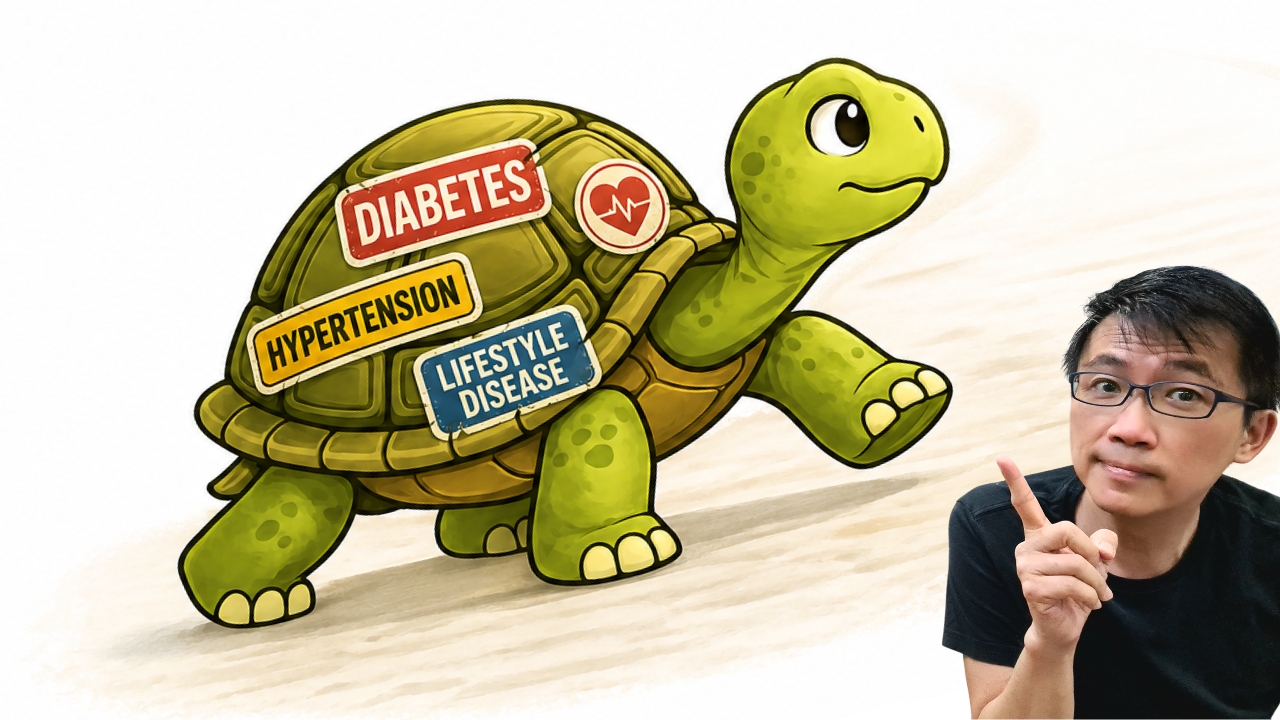
The Tortoise does not panic. The Tortoise does not deny. The Tortoise focuses on the goal, takes slow and steady steps in the right direction, calm and determined, one step at a time.
That is the best mindset to have when you receive a new diagnosis of diabetes, hypertension, or any other lifestyle-related chronic condition. Not panicky. Not in denial. Calm. Determined. Always moving forward.
Focus on 3 Things
On top of whatever your doctor has prescribed or recommended, continue to follow your doctor's instructions, continue to work closely with your doctor. And I would like to suggest that you so focus on these 3 things.
Number One: Focus on Improving Your Lifestyle Habits
We are talking about lifestyle-related chronic diseases. Lifestyle habits play a significant role. So focus there. Focus on dealing with the root of the problem, or at least a significant contributor to it.
Do not focus on looking for the best supplement, the best superfood, the best medicinal herb, or the best diet plan that promoters promise will make your disease go away. Do not turn to whatever detox plan or food hack your well-meaning friends recommend.
Focus on improving your lifestyle habits. That is where the real work is.
Number Two: Start with the Obvious
From my years of experience coaching patients with lifestyle-related chronic diseases, I have yet to meet anyone who came to me with a perfect 10 out of 10 lifestyle. Nobody. There is always room for improvement, even in areas they have already improved.
More than half of my patients with diabetes still have significant room for improvement in the area of added sugar in their diet. They know it is contributing to their problem. It is obvious it would help them to change it. And yet they have not done, or they stopped trying, satisfied that they have made some improvement, even though there is still room for more improvement left.
So I will say the obvious: Start with the obvious. The obvious still needs to be said.
To my Singaporean patients, I always say: Siew Dai is merely a milestone. Kosong is still the destination.
Cutting down from four teaspoons of sugar to two teaspoons in your morning coffee, that is an achievement. It is good. But it can still be better. Zero added sugar should remain your final destination, no matter how long you take to get there. Reduced sugar is a milestone. No sugar in drinks is the destination.
Number Three: Do It Well. Keep Making It Better.
Mai Zo, Mai Zo, Ai Zo, Zo Swee Swee.
When you attempt to change and improve your lifestyle habits, it is okay to fail. It is even normal to fail. You are trying to change habits that have been hardwired into you for decades. That is not easy.
So tell yourself: it is okay to fail. But it is not okay not to continue to try to make it better and better.
Anything worth doing is worth doing absolutely, resolutely, consistently, persistently. If something is important enough to do, it is certainly worth doing until you eventually succeed in being the best that you can be.
Making lifestyle habit changes to tackle lifestyle-related chronic diseases is one of them.
The Tortoise Always Gets There
If you have just received a diagnosis of diabetes, hypertension, or any lifestyle-related chronic condition, do not be a Kancheong Spider. Do not be an Escapist Ostrich.
Be The Tortoise. Calm. Determined. Always taking slow and steady steps in the right direction. Towards your final goal of being able to adequately and optimally control your chronic disease.
Focus on improving your lifestyle habits. Start with the obvious. Do it well. And keep aiming to do better.
Reversing Type 2 Diabetes may be possible, especially if lifestyle habits are changed and improved early enough, appropriately, adequately, and sustainably. The window does not stay open forever.
Start now. Start today.
Find out more about the Diabetes Reversal Programme by Dr Chan Tat Hon.
You May Also Want to Read
- Can Type 2 Diabetes Be Reversed? Dr Chan Answers.
- 7 Ways Stress Affects Your Blood Sugar and Diabetes
About This Episode of The Habits Pharmacy
This is Episode 1 of The Habits Pharmacy Podcast with Dr Chan Tat Hon. In this episode, Dr Chan draws on his years of clinical experience coaching patients newly diagnosed with lifestyle-related chronic diseases -- diabetes, hypertension, high cholesterol -- and explains why the Tortoise mindset is the most powerful response to a new diagnosis. He introduces the 3 Things every newly diagnosed patient should focus on, and why Siew Dai is merely a milestone and Kosong is still the destination.
The Habits Pharmacy is available on YouTube, Spotify, and Apple Podcasts. New episodes every week.
Full Transcript
If you have just been diagnosed with diabetes, high blood pressure, high cholesterol, or any other lifestyle-related chronic diseases, I want to encourage you to be the Tortoise and Focus on 3 Things. What do you think I mean by that?
Hi, I'm Dr Chan. Welcome to The Habits Pharmacy. Here, Habits are Medicine, powerful medicine intentionally prescribed to prevent control and combat lifestyle-related chronic diseases. And in this episode of The Habits Pharmacy, I want to talk about what a person who is newly diagnosed with a lifestyle-related chronic condition should do and should focus on.
But before that, I would like to share something that I often see from experience as a medical doctor, focused on training and coaching people to change their lifestyle habits to better control their chronic conditions and that is how people tend to react to the news of being newly diagnosed with diabetes, hypertension, high cholesterol, or any other chronic condition. They tend to fall into two groups. One group would turn into Chicken Littles, or in Singapore will say Kancheong Spiders and another group will choose to be Ostriches.
The Chicken Littles or the Kancheong Spiders will become all panicky and they will dive into extensive research on YouTube, join Facebook groups, searching and asking for recommendations for supplements for superfoods or herbs or food hacks that people recommend will help with their condition.
They will end up doing everything and anything, randomly and eventually actually achieving nothing.
Another group would choose to be Ostriches, burying their heads in the sand, thinking that if they ignore the problem, not think about the problem, not confront the problem, they would not be stressed by the problem, the problem being that new diagnosis of their diabetes or high blood pressure or whatever that might be a lifestyle-related chronic disease, even when they know that the problem doesn't go away simply by ignoring it, that would be their response mechanism.
So some will become Kancheong Spiders or the Chicken Littles or others will choose to be the Escapist Ostrich. I would suggest that if you're newly diagnosed with diabetes or any other lifestyle-related chronic diseases, don't choose either of them. Don't be a panicky Chicken, Kancheong Spider. Also, don't be an Escapist Ostrich.
I would recommend that you choose to be The Tortoise in the famous, The Tortoise and The Hare story that all of us are very familiar with. Just like the Tortoise in the story, you focus on the goal, take steps, slow and steady steps towards your goal, calm and determined towards your destination, one step at a time. And that is the best mindset, the best emotional state to have to respond to a new diagnosis of a chronic condition such as diabetes, hypertension, or other similar conditions, not panicky like a Chicken Little, Kancheong Spider, not complacent, not going into denial or escapism like an Ostrich burying its head in the sand, but be like The Tortoise in the Tortoise and The Hare story, determined, but calm and steady, taking steps forward in the right direction, one step at a time, one day at a time.
If you have just received the news of a diagnosis of lifestyle-related condition such as diabetes, I would strongly recommend that you focus on 3 Things, on top of whatever your doctor had prescribed or recommended to you. Continue to follow your doctor's instruction. Continue to work closely with your doctor. But I want you to also focus on 3 Things.
Number One. Focus on improving your lifestyle habits. Don't focus on looking for the best supplement, the best superfood, the best medicinal herbs, the best 23-Day, 90-Day diet plan that promoters promise will make your disease go away.
Don't turn to whatever the detox plans or food hacks recommended by your well-meaning friends. Instead, focus on improving your lifestyle habits Because we are talking about lifestyle-related chronic diseases here, where lifestyle habits play a role. So focus there. Focus on dealing with the root, or at least a significant contributor to the problem.
Number Two. Start with the obvious. The obvious aspects of the lifestyle habits that you know are clearly good to improve for your condition, where you have obvious room for improvement.
From my years of experience helping and coaching patients with lifestyle-related chronic diseases, I have yet to encounter anyone who come to me with a perfect 10 upon 10 lifestyle, where no aspects of his or her lifestyle and eating habits have any more room for improvement.
Nobody I know have a 10 upon 10, a 100% perfect lifestyle with zero room for improvement. There will always be areas that can be improved, even areas that they have already improved, there's still room for further improvements and often, it is even obvious.
For example, of the patients with diabetes that come to me for one-to-one coaching, to get my help to improve their diets to better control their blood sugar. More than half of them still have significant room for improvement in the obvious area of intake of added sugar in their diet.
All them know that it is obviously contributing to their problem, the area of added sugar in their diet, and it is obvious that it would help them if they improve that. And it is also obvious that they still have room for improvement, but yet, they have not done anything to change and improve that, or they still have further room for improvement, but they stopped trying.
So I'm going to say the obvious. The obvious still need to be said, and that is Start with the Obvious. That is Number Two -- Start with the obvious areas in your lifestyle and diet that needed improving.
And number Three. Do it well. Keep making it better and better. Mai Zo Mai Zo, Ai Zo Zo Swee Swee. When attempting to change and improve any aspects of your lifestyle and eating habits, It is okay to fail. It is even normal to fail. Whenever you try to change or improve anything, especially something as difficult as trying to change lifestyle and eating habits that have been hardwired into you for decades, for tens of years, from the time you have the ability to make choices, lifestyle choices on your own.
So it is not easy. It is okay to fail. It is even normal to fail. So tell yourself, when embarking on lifestyle change, that it is okay to fail, but it is not okay not to continue to try to make it better and better and better.
Let me share with you a very common situation, a very common experience that I would have with patients that I coach. Many patients with diabetes will say to me, "Doctor, ever since I got diagnosed with diabetes five years ago, I have reduced my sugar intake. Right now, for this past five years, I'm only adding two teaspoons of sugar in my morning coffee instead of my usual four teaspoons that I used to do before that five years ago." And I'll look at them and say, "And...... since you made that switch from cutting down from four teaspoons of sugar in your coffee to only two teaspoons five years ago, have you cut that down even more since? Have you become even better in this particular aspect of your diet since?"
And they will look at me, perplexed because to them cutting down from four teaspoon to two teaspoons of sugar in their coffee, that was an achievement and that was good enough, and I do not deny that. It is well done. It is an achievement. It is good. But I will still say to them when it comes to something like cutting down sugar that you choose to add to your cup of coffee, which is discretionary and easily within your control, cutting down from four teaspoons of sugar to two teaspoons of sugar. It is very good, but it can still be better, which is no added sugar, zero added sugar in your coffee.
To my Singaporean patients, I will always say, Siew Dai is merely a milestone, Kosong is still your final destination, meaning that cutting down to two teaspoon of sugar per cup of coffee is a great milestone, but getting to a habit of learning to enjoy your coffee without the need of any added sugar, with zero added sugar should still remain your final destination no matter how long you take to get there.
Siew Dai is merely a milestone. Kosong is still the destination. Reduced sugar is merely a milestone. No sugar in drinks is still your final destination, no matter how long you take to get there.
Whenever I conduct Habits as Medicine training or workshops, I can often be found saying "Anything worth doing, is worth doing Absolutely, Resolutely, Consistently, Persistently. Mai Zo Mai Zo, Zo Zo Swee Swee. If something is important enough, it is certainly worth doing and trying until we eventually succeed in being the best that we can be. And making lifestyle habits changes to tackle lifestyle-related chronic diseases, is one of them. So that is number three -- Focus on doing it well, do it better.
So that is what I mean when I said at the beginning of this episode of The Habits Pharmacy, that if you have just been diagnosed with diabetes, hypertension, or any lifestyle-related chronic diseases, be The Tortoise, not a panicky Chicken Little or Kancheong Spider and neither an Escapist Ostrich, in denial, but The Tortoise who is calm, determined and always taking slow and steady steps in the right direction, towards your final goal of being able to overcome, being able to adequately and optimally control your chronic disease. And focus on 3 Things. Focus on improving your lifestyle habits. Start with the obvious and do it well, and keep aiming to do better, and better.
And if you have diabetes, and if you want to build a strong foundation of understanding diabetes reversal, I have a structured online learning program called Reversing Type Two Diabetes, the Essential Basics. If you are keen to find out more, the link should be somewhere in the description or notes of this episode, depending on where you are watching or listening to this podcast.
Go to my websites, www.TheHabitsDoctor.com or TheHabitsPharmacy.com, you should find the info there. I hope you have enjoyed this episode of The Habits Pharmacy Podcast and found it useful. I'm Dr Chan. Let Your Habits Be Your Medicine to combat lifestyle-related chronic diseases. See you at the next episode, and until then, Eat Well and Be Well.
About Dr Chan, Founder & Medical Director of The Habits Pharmacy
Dr Chan is a medical doctor from Singapore who trains and coaches people to holistically review, change and improve their Lifestyle & Dietary Habits to prevent, control and combat Diabetes, Hypertension, High Cholesterol, Cardiovascular Diseases and other Lifestyle & Diet related chronic diseases. Find out more about Dr Chan, his work, 1-1 coaching programmes, workshops & courses, click on the Find out More button below.
Subscribe to
The HABITS Pharmacy - Habits as Medicine
newsletter
for regular tips & updates on courses and workshops to be equipped to unlock the Power of Habits as Medicine to Prevent and Combat Lifestyle-related chronic diseases.
Unsubscribe anytime