Is BASMATI RICE LOW GI? Are all Basmati Rice Low Glycemic Index?
Jun 27, 2021
Is basmati rice low GI? The short answer is: not all basmati rice qualifies as low GI. The glycemic index of basmati rice ranges from the low 50s to the 60s, placing it in the low to medium GI category, depending on the specific variety and how it was processed.
This is one of the most common questions I hear, especially from patients who have been told to "switch to basmati rice" as part of managing their blood sugar. The answer is more nuanced than a simple yes or no. Let me explain.
Watch my short video below, or read on for the full answer.
Watch: Is Basmati Rice Low GI? Dr Chan Answers
Is Basmati Rice Low GI? It Depends.
Many people assume all basmati rice is low GI. That is not accurate.
The glycemic index of a food can only be confirmed by sending that specific product to a GI testing laboratory to have it tested. If the tested GI value is 55 or below, it qualifies for a low GI label. If it has not been tested, you cannot assume it is low GI, even if it is basmati rice.
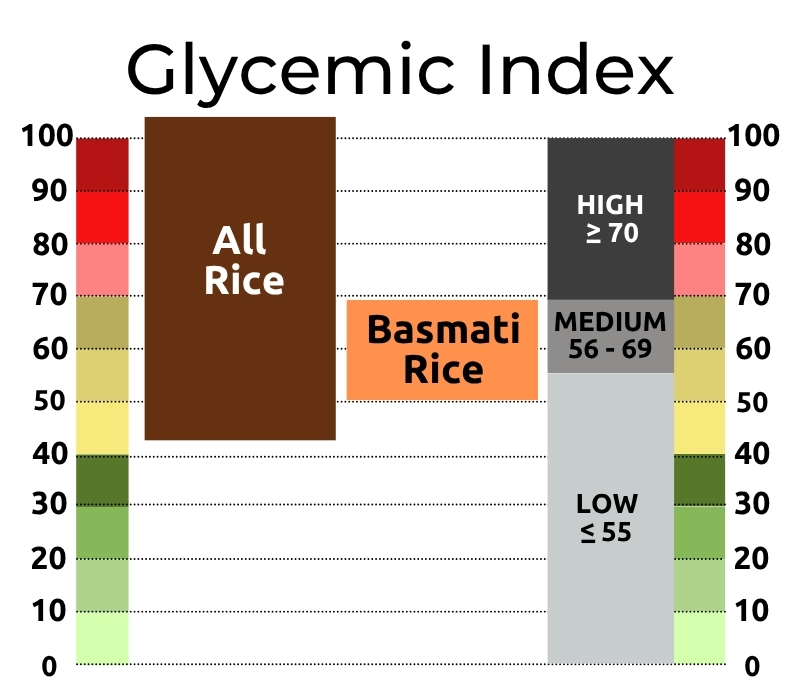
Based on the published GI values in the International Glycemic Index Database, maintained by the University of Sydney, basmati rice has a GI ranging from the low 50s to the 60s. Using the standard classification, a GI of 55 and below is Low GI, 56 to 69 is Medium GI, and 70 and above is High GI.
This means some basmati rice falls in the Low GI category. But some falls in the Medium GI category. It depends on the origin, the variety, and the processing.
Here is a practical rule. If the bag of basmati rice you bought does not display a specific GI value or a certified Low GI label on the packaging, it was not sent to a testing lab. You cannot assume its GI is low. You can only say that its GI is likely somewhere within the range of 50 to 60-plus, based on what other basmati rice varieties have shown.
Basmati Rice Is Lower in GI Than Most Other Rice. But That Is Not the Same As Low GI.
Here is a distinction worth understanding clearly.
Rice, across all varieties, has a GI that can range from the 40s to above 100. Many types of white rice, particularly short-grain and jasmine rice, fall well above 70. That is the High GI range.
Basmati rice, with its GI typically in the 50s to 60s, is therefore generally lower in GI than most other rice.
Graphic: the glycemic index range of basmati rice compared to the glycemic index range of all rice
If Basmati Rice is low to medium GI, what about other rice?
Many patients ask: what about brown rice or parboiled rice? are they comparable to basmati rice in terms of glycemic index?
These are the follow-up questions I hear most often,
The answers are specific and depend on the actual GI values of the products in question.
But the principle remains the same. Unless a specific product has been tested and labelled, you are working with a range, not a fixed number.
It is important to also know that even though a specific rice product may have been tested in a GI lab and certified low GI, its actual impact on a person's blood sugar depends on many other factors - including how the rice is cooked, what it is eaten with, the health of the person eating it.
The More Important Question for People with Diabetes
After I explain all of this to my patients, most of them nod and then ask: "So, Doctor, is basmati rice good for me if I have diabetes?"
The question is not just whether basmati rice is low GI or medium GI. The more important question is: what is your overall eating pattern doing to your blood sugar? How much rice are you eating at each meal? What else is on your plate? How often do you eat rice? What does the rest of your day look like in terms of food, activity, and sleep?
I often hear patients ask questions that go even deeper once they understand the GI concept: does it matter how I cook the rice? What if I cool it down before eating, does that lower the GI? What about eating rice with lentils or vegetables or healthy fats? Does that change the glycemic load of the whole meal?
These are the right questions for a person with diabetes to be asking. And they deserve proper, specific answers. I will be covering these in detail in separate posts and videos.
For now, the key point is this. Knowing the GI of the specific bag of uncooked basmati rice you have in your pantry may be a useful starting point. It gives you one piece of information, but you must be mindful that actual impact on your blood sugar depends on many other factors - including how you intend to cook that rice, what you plan to eat it with (rice is almost never eaten on its own), the temperature of the rice when you eat it, your insulin sensitivity and many other factors that determine the final glycemic index of the whole rice meal, beyond just the lab tested GI of the uncooked basmati rice you made the meal from.
More importantly, no single food, eaten in isolation, determines your blood sugar control. Your overall lifestyle and eating habits, and how that affect your insulin sensitivity and insulin production response, are key factors that would determine the blood sugar impact of any meal, beyond just the glycemic index of the meal or the components of the meal.
Managing Blood Sugar for Diabetics - Beyond the GI of Basmati Rice
Here is my takeaway for you.
If you are managing diabetes or prediabetes, switching from high GI rice to low to medium GI basmati rice may sound like a logical helpful thing to do. But it would be wrong to over-estimate the impact of that for overall blood sugar control, because the impact of any meal on one's blood sugar is multi-factorial and complex and goes beyond the glycemic index of one of the uncooked ingredient in a mixed cooked meal.
So beyond just just switching rice varieties, from generally higher GI rice to generally lower GI rice varieties, I would encourage you to also look at: How much rice? How often? What else is on the plate? What is the total eating pattern?
The choice of rice you buy from the supermarket, often ranks below what you do with the rice and how you eat the rice, in terms of blood sugar impact. Also, beyond just choice of rice, don't forget the greater impact of one's overall eating and lifestyle habits.
In fact, I always try to remind my patients to not lose sight of "All aspects of lifestyle and eating habits on All aspects of body physiologies on All aspects of health for All of lifetime." Not easy to do, but a must do nonetheless. It is easy to miss the woods for the trees, getting lost in the rabbit hole of specifics and losing sight of the more important big picture.
So, for every diabetic who ask me, "Doctor, is basmati rice low GI?", at risk of being misunderstood, the answer I most want to give to that would be, "Is that the most important or even right question? If why you are asking this is because you want to control your blood sugar and manage your diabetes better? How much time do you have, because the answer is not just a Yes or No."
Ask better questions about what you are eating and why. Start now. Start today.
Learning About Reversing Type 2 Diabetes
If you have diabetes and are not as equipped with the essential foundational knowledge about reversing Type 2 diabetes as you should be, I have a structured online learning programme that you might find very useful. You can find out more through the link below.

Frequently Asked Questions
Is basmati rice good for people with diabetes?
Basmati rice is a better choice than most other white rice varieties because it has a lower GI. However, it is not a free food for people with diabetes. The amount you eat, how often you eat it, and what you eat it with all affect how it impacts your blood sugar. Choosing lower GI rice is one useful step in a broader eating pattern.
Does the GI of rice change depending on how it is cooked?
Yes, it can. How rice is cooked, and whether it is eaten hot or cooled before eating, can affect its GI. Cooling cooked rice increases the amount of resistant starch, which is digested more slowly. This is a topic worth understanding more deeply if you are managing diabetes. I will be covering this in a dedicated post.
Related Posts on Diabetes, Food, and Lifestyle
- Can Type 2 Diabetes Be Reversed? Dr Chan answers.
- Are Oats Good for Diabetes?
- Is Honey Good for Diabetes?
- Reversing Type 2 Diabetes: Essential Basics - Structured Online Learning Programme
About This Video
In this short video, I tackle one of the most commonly asked food questions among patients managing diabetes and blood sugar: is basmati rice low GI? I look up the actual GI values from the International Glycemic Index Database, explain what the range means, clarify what a Low GI label on packaging actually tells you, and explain the difference between basmati rice being lower in GI than most other rice and basmati rice being definitively low GI. I also share three key conclusions that will help you make a genuinely informed choice.
Full Transcript
The following is the full transcript of the video above.
Is basmati rice low GI? What do you think? Is basmati rice a low glycemic index, a low GI food.
Many people seem to think so but is it really so? In this short video, I shall tackle this very common question. Hi, if you are new here, I'm Dr Chan, I'm a medical doctor from Singapore welcome to The Daily Dose. In this episode, let's tackle this question - Is basmati rice low GI or more specifically are all basmati rice low GI? I will not be tackling, not in this video, all these other questions and aspects of basmati rice that most people would also ask.
Let's start with looking up the GI of basmati rice. And we can see that it is a range, mainly in the low 50s to 60s. That is also another thing that many people usually do not know or may not realize, which is the GI of a food can vary, depending on where it is produced, how it is processed or prepared. So unless a food is specifically defined or tested at the GI testing lab and has its GI specifically measured, we will not be able to give or assume a specific GI number to any food. For example, this basmati rice that I got from a supermarket here in Singapore, the GI of this specific basmati rice from this particular brand is 51. How did I know that? Because the information was on the packaging. Food products can display a low GI label or a specific GI value or GI number on its packaging only if it had been sent to a lab and tested and had its GI measured and given a specific GI value. And if the tested GI value is 55 and below, the product then qualifies for a Low GI label to be displayed on this packaging. So if the basmati rice that you bought does not have any specific GI number on this packaging, you cannot assume that the GI of the basmati rice that you have is also the same as the one that I have here which is 51. You cannot even assume that the basmati rice that you have is low GI if there's no GI value or label on the packaging. You can only assume that the GI value of the basmati rice that you have may fall somewhere within the range of GI values of all the different basmati rice ever tested and has its GI values published. My go-to place online to look for GI information of foods is to go to the International Glycemic Index database website maintained by the University of Sydney in Australia. It has the largest most updated database of GI values of almost every food product ever tested from all the different labs from around the world. So from my search just now, you could see that basmati rice have GI values ranging from the low 50s to the 60s. Which if we go by the conventional Low, Medium, High GI classification, basmati rice will fall in the low to medium GI categories.
So what does this mean? Why then do most people generally say that basmati rice is low GI. Let me put it this way, it is wrong to say that all basmati rice is low GI but we can say that basmati rice in general falls in the lower range of GI when compared to all the other different types of rice. That is because the GI value of rice, the many many different types of rice, can range from the 40s to more than 100. So basmati rice with its GI ranging in the low 50s to 60s is lower in GI than most rice in general.
For those of you who are not familiar with the concept of GI, how it is measured, how it is classified, I have done a detailed video on this, I shall put the link in the description. I hope this answers the question of whether basmati rice is low GI. In conclusion, we can say this - Number One, not all basmati rice fall in the low GI category. Number Two - basmati rice, depending on the specific source and processing, can have a GI that falls somewhere in the low 50s to 60s range, that is in the low to medium GI classification. Lastly, despite saying that not all basmati rice qualifies to be classified as low GI, we can still say that basmati rice, in general, is lower in GI than most but not necessarily all other types of rice. And also, other than rice, there are many other foods that we could choose that are lower in GI than most rice, including basmati rice. But I'm not going to cover that in this video.
And here, I think many of you might also ask these two follow-up questions - Number One, does it mean that, compared to other types of rice, basmati rice would not spike blood glucose as much. And Number Two - is basmati rice good for people with diabetes? I have done a few other videos that are relevant to these questions, although not specifically. If you are interested, suggest you go watch these videos later. I shall put the links in the description as well.
Also, I think some of you watching this might complain that I spent so much time to cover in such detail this simple and seemingly straightforward question of whether basmati rice is low GI or not. And you'll be saying. 'Doctor, why can't you just tell me - Yes or No? I can only say that, when it comes to learning about food choices that will impact our health, it is worthwhile and important, to spend a little bit more time, to clarify misconceptions, learn the topic in enough detail, to understand and appreciate the nuances to be able to make the best informed food choices.
That's all I shall cover in this video, I hope you have found it useful, thank you for watching this episode of The Daily Dose. I'm Dr Chan, Let Habits be Thy Medicine, let's unlock the power of a healthy lifestyle and eating Habits as Medicine, One Dose, One Habit at a Time.
---------- End of video transcript ----------

About Dr Chan, Founder & Medical Director of The Habits Pharmacy
Dr Chan is a medical doctor from Singapore who trains and coaches people to holistically review, change and improve their Lifestyle & Dietary Habits to prevent, control and combat Diabetes, Hypertension, High Cholesterol, Cardiovascular Diseases and other Lifestyle & Diet related chronic diseases. Find out more about Dr Chan, his work, 1-1 coaching programmes, workshops & courses, click on the Find out More button below.
Subscribe to
The HABITS Pharmacy - Habits as Medicine
newsletter
for regular tips & updates on courses and workshops to be equipped to unlock the Power of Habits as Medicine to Prevent and Combat Lifestyle-related chronic diseases.
Unsubscribe anytime